
Purchase Your Ticket
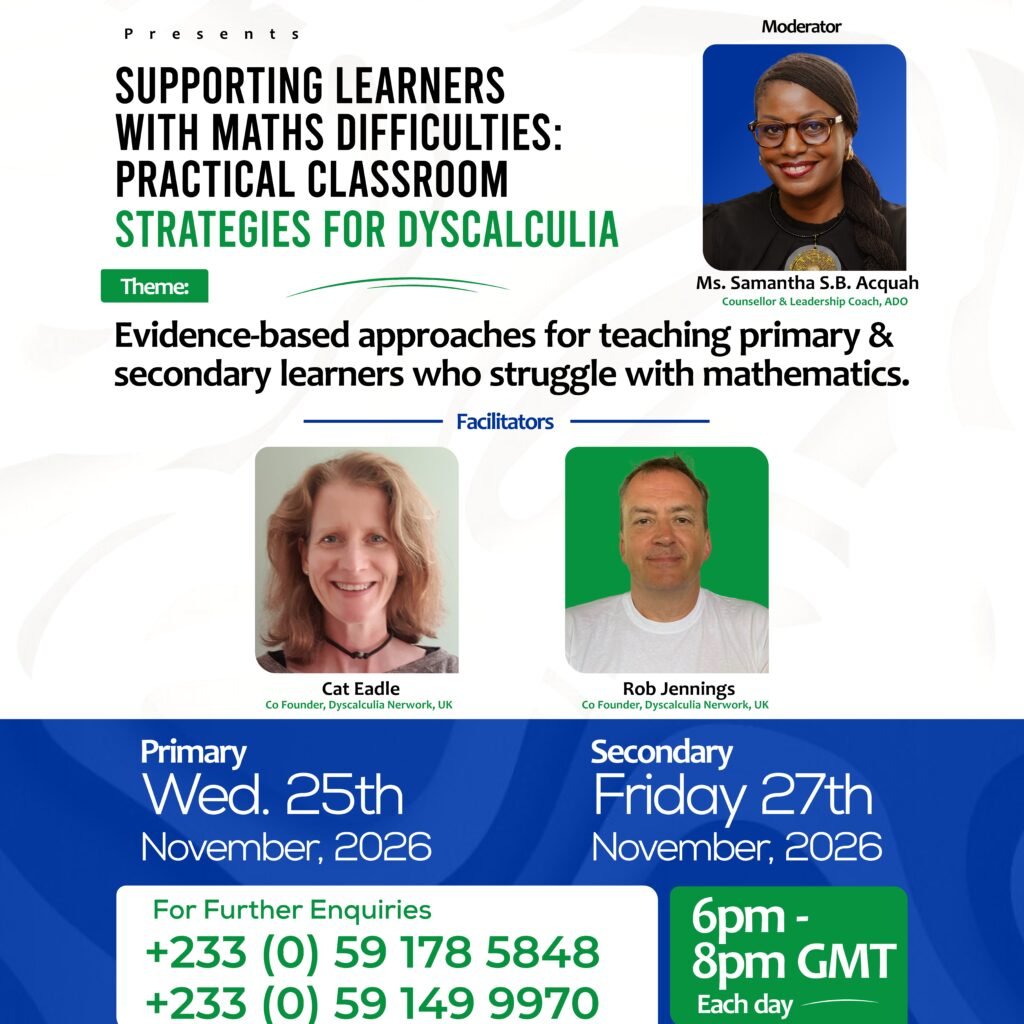
Supporting Learners with Maths Difficulties: Practical Classroom Strategies for Dyscalculia
Gain practical, evidence-based strategies to support learners with dyscalculia and mathematics difficulties. These interactive workshops are designed for classroom teachers, special educators, learning support professionals, school leaders, teaching assistants, and anyone working with learners who struggle with mathematics.
Facilitators
- Cat Eadle – Co-Founder, Dyscalculia Network, United Kingdom
- Rob Jennings – Co-Founder, Dyscalculia Network, United Kingdom
Moderator
- Ms. Samantha S. B. Acquah – Counsellor & Leadership Coach, Africa Dyslexia Organisation
Session 1: Secondary Learners (For High School Teachers)
Date: Friday, 27 November 2026
This session focuses on intervention strategies for more advanced mathematical concepts, including fractions, decimals, percentages, and algebra. Participants will learn practical, inclusive approaches that make abstract mathematical concepts accessible for learners with dyscalculia.
Learning Outcomes
- Understand the importance of assessment in planning intervention.
- Identify the prerequisite skills required for fractions, decimals, percentages, and algebra.
- Explore multisensory teaching using the CPVVA approach and everyday classroom manipulatives.
- Learn engaging games and classroom activities that strengthen conceptual understanding of higher-level mathematics.
Session 2: Primary Learners (For Primary School Teachers)
Date: Wednesday, 25 November 2026
This session focuses on evidence-based intervention strategies for teaching the four core mathematical operations (addition, subtraction, multiplication, and division) to learners with dyscalculia and mathematics difficulties. Participants will explore inclusive teaching practices, multisensory instructional approaches, and engaging classroom activities that improve mathematical understanding.
Learning Outcomes
- Understand the importance of assessment in planning effective intervention.
- Learn intervention strategies for teaching addition, subtraction, multiplication, and division.
- Explore multisensory teaching using the CPVVA approach and everyday classroom manipulatives.
- Discover practical games and activities that strengthen understanding of the four operations.
Training Details
Time
6:00 PM – 8:00 PM GMT
Venue
Live Online via Zoom
Registration Contribution
- Early Bird (register by 20 August 2026): GH₵350 per session
- Regular Registration (register by 15 September 2026): GH₵450 per session
Participants may register for either session individually or attend both sessions.
Who Should Attend?
- Primary and secondary school teachers
- Special education teachers
- Learning support teachers
- SEN coordinators
- School leaders
- Teaching assistants
- Tutors
- Parents supporting children with mathematics difficulties
- Teacher trainees and education professionals
What Participants Will Receive?
- Live interactive training with internationally recognised dyscalculia specialists.
- Practical classroom resources and teaching ideas.
- Evidence-based intervention strategies that can be implemented immediately.
- Opportunity to ask questions during the live sessions.
- Digital Certificate of Participation from the Africa Dyslexia Organisation.
